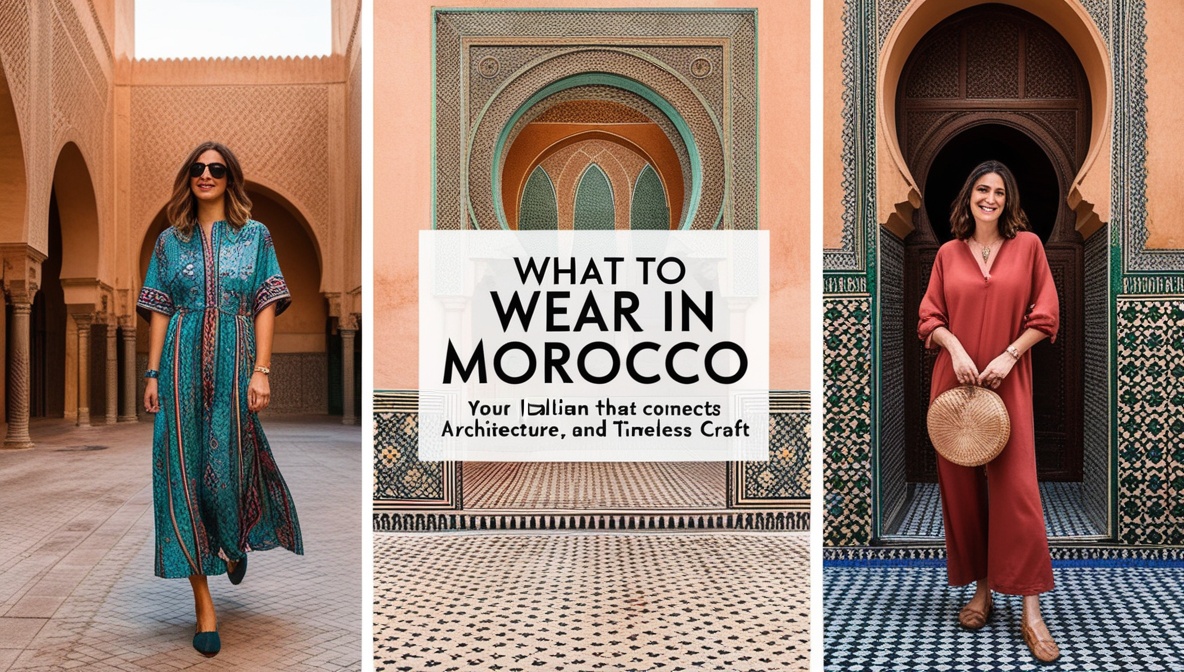
What to Wear in Morocco: Your Honest, Complete Guide
There’s a moment almost every traveler has, usually while standing in the middle of a Marrakech souk with sweat on their neck and sand between their toes, where they think: I wish someone had just told me what to pack. This article is that someone. I’ve absorbed the experiences of dozens of travelers, tour guides, expats, and Moroccan locals to give you the clearest picture possible. Not rules. Not shame. Just honest, kind advice that helps your trip go smoothly.
Let’s start with the most important truth of all: Morocco is not one single place. It has freezing mountain towns, sun-scorched desert dunes, breezy Atlantic beach towns, and ancient city medinas where men carry live chickens past teenage girls in ripped jeans. It contains multitudes. What you wear in Casablanca’s coffee shops feels different from what works wandering the alleys of Fes. That’s part of what makes this country so alive.
Key Facts
| Topic | What You Should Know |
| Religion | Majority Muslim; modesty in dress is culturally valued |
| Legal requirements | No clothing laws for tourists; no dress code police |
| Head covering | Not required for foreign women; useful scarf for mosque visits |
| Ideal fabrics | Linen and cotton for heat; wool layers for mountains/desert nights |
| Best colors | Light neutrals (beige, white, pale blue) reflect sun; earthy tones blend in beautifully |
| Footwear | Sturdy, closed-toe walking shoes for medinas; sandals fine at coast |
| Swimwear | Fine at beaches, pools, and hotel riads; cover up when leaving those areas |
| Shorts for men | OK at coast and tourist zones; long trousers better in medinas and rural areas |
| Shorts for women | Best avoided in medinas, markets, and villages; fine at beach |
| Traditional garment | Djellaba (hooded robe); buying one locally is encouraged and celebrated |
| Mosque visits | Shoulders, knees, and cleavage covered; shoes removed; scarf handy for women |
| Desert packing | Layers are everything; light by day, warm jacket for night |
| Shopping | Buy beautiful things locally — souks in Marrakech and Fes are extraordinary |
| Season surprise | Winters are genuinely cold; mountain towns can freeze even in spring |
Why What You Wear Actually Matters Here
Let’s be honest with each other. Packing for Morocco confuses people because they’ve usually heard two opposite things. Either “dress very conservatively or you’ll have problems” or “it’s totally chill, wear whatever.” Both of those are partially true, and neither is the full picture.
Morocco is a Muslim-majority country with deep cultural roots in modesty. But it also welcomes millions of visitors a year and is far more relaxed about tourist clothing than many other countries in the region. Nobody is going to arrest you for wearing shorts. Nobody will physically stop you.
What happens instead is more subtle. In more traditional neighborhoods, revealing clothing often draws stares, unsolicited comments, or simply a cooler reaction from the people around you. In the medinas of Fes or quiet mountain villages, covering up changes how people look at you. And often, it changes how people talk to you — with more warmth, more ease, more genuine welcome.
A solo female traveler once described it this way: she wore tight leggings into the Djemaa el-Fna on her first day in Marrakech and felt eyes everywhere. She switched to wide linen trousers the next morning and said the whole city felt different. The same streets, but a warmer world.
That’s the real reason to dress thoughtfully here. Not because someone will punish you. But because it opens doors.
And there’s a purely practical reason too: loose, long clothing genuinely keeps you cooler in the heat. Moroccan nomads figured this out centuries ago. Flowing fabric traps a pocket of air against your skin. It shields you from direct sun. It deflects sand in the desert. Full coverage, when the fabric is light enough, actually works better than shorts on a 40°C afternoon.
A Quick Look at Morocco’s Own Clothing Culture
Before we talk about what tourists should wear, it helps to understand what Moroccans actually wear. Because it’s not all caftans and headscarves. It’s a fascinating mix.
Walk through Casablanca and you’ll see men in polo shirts and chinos, women in jeans and blazers, and older gentlemen in beautifully embroidered woolen djellabas. All three on the same street, at the same time.
The djellaba is Morocco’s most beloved everyday garment. It’s a long, loose robe with wide sleeves and a distinctive pointed hood. The hood — called a qob — was designed for the desert. It blocks sun, traps warmth, deflects blowing sand, and doubles as a rain shield. Berber tribes developed practical versions of it centuries ago. Today it’s everywhere: farmers, city professionals, students, and royalty all wear it. The King of Morocco himself appears publicly in a white djellaba on religious occasions.
Women’s djellabas come in every color under the sun — deep rose, cobalt blue, gold embroidered on green. Men tend to stick to solid neutrals: white, beige, camel, gray. Younger Moroccan men often prefer Western clothes for daily life, saving the djellaba for prayer, festivals, and family events.
The kaftan is a different thing entirely. Outside Morocco, it gets sold as beachwear or lounge wear. Inside Morocco, it’s formal. A bride might change into seven different kaftans at her own wedding. They appear at celebrations, Eid gatherings, engagement parties. Each one is a piece of art — embroidered by hand with geometric patterns, silk thread, or metallic accents. Women often have theirs custom-made, bringing their own fabric to a local designer called a mosamima.
The takchita is the kaftan’s more elaborate cousin: a two-layer ceremonial gown worn at weddings and major events. You probably won’t see it unless you’re lucky enough to be invited into someone’s home for a celebration.
For daily outdoor wear, men also wear the gandora, a short-sleeved or sleeveless tunic. Women wear babouches — soft leather slippers in yellow, gold, and every other color. The sheshia and fez hats appear on special occasions. And in the Sahara, the Berber cheche — a long woven scarf — gets wrapped expertly around the head as both sun shield and dust mask.
When you see all of this clearly, tourist fashion advice starts to make more sense. It’s not about arbitrary rules. It’s about understanding what this culture considers appropriate for which setting.
For Women: What Actually Works
This is where most of the questions come from, so let’s spend real time here.
The foundational principle is simple: cover your shoulders and your knees in public spaces that aren’t a beach or a hotel pool. That’s it. That’s the heart of it.
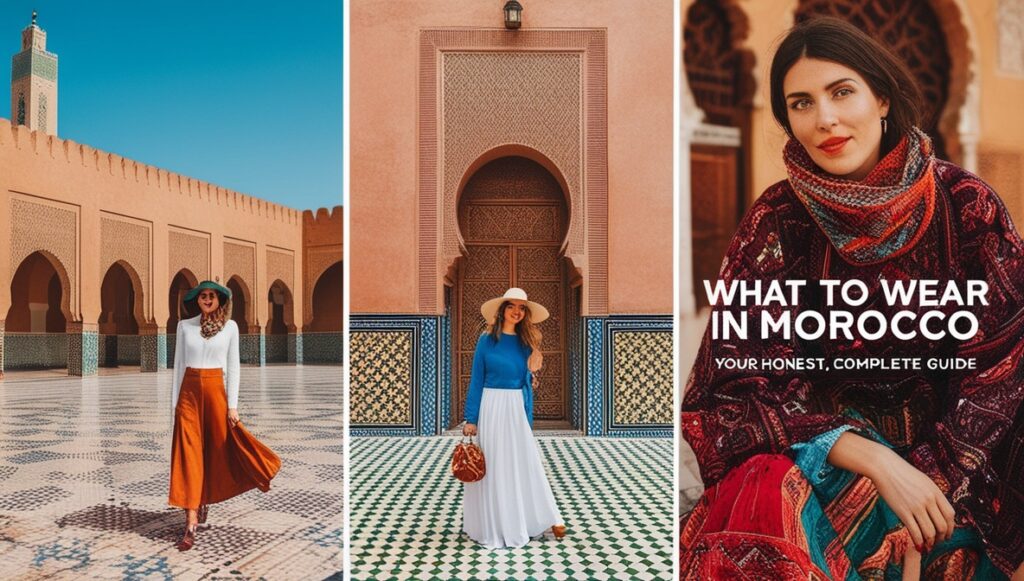
Within that principle, you have enormous freedom. Long linen trousers look great and feel amazing in the heat. Maxi dresses and midi skirts are both elegant and practical. Loose cotton blouses worn over leggings work beautifully. A tunic over wide-leg pants photographs spectacularly against Moroccan architecture and feels like wearing nothing at all.
You do not need to cover your hair. Full stop. Moroccan women themselves make their own choices about headscarves — you’ll see women with hijabs and women with their hair flowing in the same street market. Foreign visitors are absolutely not expected to cover up. The one exception is formal mosque visits. The Hassan II Mosque in Casablanca — one of the few mosques in Morocco that non-Muslims can enter — requires you to cover your hair upon entry. A lightweight scarf in your bag solves this in about eight seconds.
Speaking of scarves: pack at least one. A large, lightweight scarf is the single most useful item in your Morocco bag. It goes around your shoulders in a cool medina alley. It wraps around your neck at a desert campfire. It drapes over your head for a mosque. It becomes a blanket on a night bus. It keeps the Sahara sand out of your face. Buy a beautiful one in a local souk if you don’t bring one — they’re everywhere and deeply affordable.
Avoid tight-fitting clothing in traditional areas. It’s not just about coverage. Even fully covered but skin-tight leggings in conservative neighborhoods can attract unwanted attention. The goal is loose and covered.
For evenings at nice riads or rooftop restaurants, you can dress up beautifully. Long flowing dresses, embroidered blouses, sandals with a little heel — all completely fine in that setting. The dress code loosens significantly when you’re in a private or upscale space.
And one of the most genuinely fun things you can do? Buy a djellaba at a souk early in your trip and wear it for a day. Moroccans love this. It’s one of the fastest ways to get a warm smile from a shopkeeper, a nod from an elder, a spontaneous conversation about where you found it. Wearing local clothing — even imperfectly — signals that you came here to connect, not just to photograph.
For Men: Less Discussed, Still Matters
Men’s dress code doesn’t get as much attention in Morocco travel guides. That can lead to the wrong assumption that anything goes.
It doesn’t. Not quite.
Long trousers are the respectful default across most of Morocco. In medinas, religious sites, rural towns, and mountain villages, long pants signal that you’re paying attention. In Fes — one of Morocco’s most traditionally religious cities — shorts in the medina can get you chilly glances.
In tourist areas, coastal towns, and resorts, shorts are completely fine. In Marrakech’s modern Gueliz neighborhood, shorts aren’t particularly strange. On the beaches of Agadir or Essaouira, wear whatever you like.
Sleeveless shirts — the classic tank top — are best left for the pool. In markets and streets, a short-sleeved or long-sleeved shirt is the move. Collared shirts fit in effortlessly with how younger Moroccan men dress.
Light colors are your friend in summer. White, beige, pale blue, and light gray keep you dramatically cooler than dark fabrics. Cotton and linen are the gold standard for breathability. Jeans work but can become genuinely uncomfortable when temperatures climb past 35°C.
For mosque visits, long trousers and a shirt with sleeves are essential. Shoes come off at the entrance, so slip-on footwear saves time and dignity.
Dressing by Location: The Regional Differences
Morocco is geographically diverse enough that what you need shifts significantly depending on where you go.
Marrakech is Morocco’s most visited city and one of its most relaxed when it comes to tourist clothing. The medina still calls for modest dress, but the newer neighborhoods like Gueliz feel almost cosmopolitan. Evenings in nice restaurants can be an opportunity to dress up a little.
Fes is Morocco’s most ancient city and its most traditionally conservative. The medina here — the largest car-free urban area in the world — has a genuine old-world atmosphere. Women especially should keep shoulders and knees covered at all times while walking through it. The rewards for dressing respectfully are extraordinary warmth from locals.
Chefchaouen — the famous Blue City — draws a lot of visitors and has a slightly artsy, laid-back energy. It’s still a traditional mountain town though. Modest dress is appreciated even as the crowds mean people see all kinds of tourists.
Essaouira and Agadir on the Atlantic coast have a noticeably more relaxed vibe. Coastal winds keep temperatures milder. Shorts are more commonly seen. Swimwear is fine at the beach. Cover up when you head into town.
The Atlas Mountains are cold. Not “cool” — actually cold, especially at night, and sometimes even during the day in winter. Pack fleeces, a proper jacket, warm socks. Modesty still matters in the Berber villages you’ll pass through.
The Sahara Desert deserves its own entire section.
The Sahara: Where Dressing Right Is About Survival, Not Just Culture
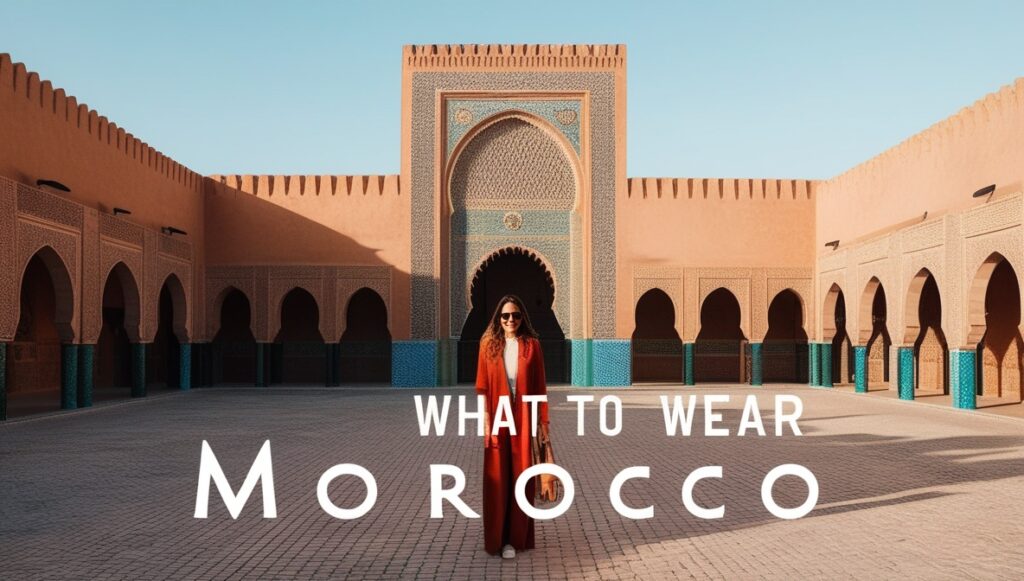
The Sahara is a place of extremes that most people aren’t prepared for. Temperatures can hit 45°C at noon and drop to near-freezing after midnight. Sand blows in all directions. The sun is unforgiving. And most tourists underestimate all of it.
Here’s what actually works for desert visits:
During the day, you want lightweight, long-sleeved coverage. Loose linen shirts and light cotton trousers work beautifully. Long sleeves in breathable fabric protect against UV rays and blowing sand simultaneously. Shorts leave your legs unprotected from both, and if you’re riding a camel, bare legs on a saddle is a mistake you’ll remember for days.
At night, you need real layers. A light fleece isn’t enough. A proper down jacket, thermal base layers, warm socks, and a hat for December and January visits. Many people are surprised to find themselves genuinely shivering at a Sahara campfire in Morocco.
The cheche — the traditional Berber head scarf — is worth buying in Morocco for desert use. Local guides and crew will show you how to wrap it if you ask. It protects your face from sandstorms, shades your neck from sun, and looks spectacular for photos. Buy the longest one you can find.
Closed-toe shoes are essential for desert walking. Sand hides scorpions and sharp rocks. Sandals are fine around camp but not for dune trekking.
For camel rides specifically: wear full-length trousers. No exceptions. A long camel ride in shorts will leave you chafed and unhappy.
Seasonal Guide: What Changes Month to Month
People often picture Morocco as permanently hot. It isn’t.
Summer (June–August) is genuinely intense in cities like Marrakech and Fes, where temperatures often exceed 40°C. Light colors, linen and cotton, loose cuts, a hat, and sunscreen become non-negotiable. The desert is brutally hot in summer — many experienced guides suggest avoiding it entirely in July and August if you can.
Autumn (September–November) is one of the best times to visit. Temperatures are warm but manageable. Lighter layers work well most of the time, with a light jacket handy for evenings.
Winter (December–February) surprises almost everyone. Marrakech stays relatively mild — think 18–22°C during the day — but Fes, Chefchaouen, and the Atlas Mountains can be genuinely cold. Pack a real winter coat for northern cities. Desert nights near Merzouga can drop close to freezing. Nobody ever regrets bringing an extra warm layer to Morocco in winter.
Spring (March–May) is gorgeous. Perfect for both trekking and medina wandering. Temperatures are comfortable. Pack light layers that you can add or remove throughout the day.
The Shoes Question
Comfortable shoes will make or break your experience. The medinas of Marrakech and Fes are labyrinths of ancient cobblestones, uneven surfaces, narrow alleys, and the occasional surprising step. Pretty shoes that offer no grip or support will leave you exhausted before noon.
Wear sturdy, broken-in walking shoes. Trainers are completely fine. Hiking shoes are great for mountain trips. Sandals with proper straps work for coastal areas and calm afternoon strolls. Flip-flops are for pools and riads, not for marathon medina days.
Babouches — the traditional Moroccan leather slippers — are beautiful and worth buying as souvenirs. They’re genuinely not ideal for long walking days, though. Most visitors buy them and discover this the interesting way.
Shopping for Clothes Locally: A Hidden Gem
One of the most joyful things about Morocco is that you can solve almost any packing mistake by shopping locally. The souks are full of beautiful, affordable, culturally perfect options.
A simple cotton djellaba costs very little and solves most of your cultural dress code needs in one garment. Handwoven scarves in every color exist at stalls in every medina. Linen tunics and wide trousers are available in Marrakech for reasonable prices.
In Fes, high-end leather boutiques sell beautifully made items at a fraction of European prices. In Essaouira, small indie shops carry light cotton pieces perfect for coast and city both. In Marrakech, a neighborhood market called Souk L’ghzal sells vintage caftans at genuinely wonderful prices.
When you shop in souks, haggling is expected and actually fun once you get the rhythm of it. Start lower than you want to pay. Be friendly, not aggressive. It’s a conversation, not a fight. And know that leaving a stall without buying is completely fine.
Common Misconceptions Worth Clearing Up
“You’ll be forced to wear traditional Moroccan clothes.” No. Nobody will force you into anything. Modest Western clothing is completely accepted everywhere.
“Women must cover their hair at all times.” Absolutely not. It’s not expected of tourists anywhere except specific mosque interiors. Even most Moroccan women themselves make their own choice about headscarves.
“Morocco is too conservative for any kind of beach vacation.” Bikinis are fine at beaches, hotel pools, and resorts. You just cover up when you walk back into town.
“Men can wear anything they want.” Mostly true, but long trousers and sleeved shirts are more respectful in traditional areas. Cultural respect applies to all genders.
“All of Morocco has the same vibe.” This might be the biggest misconception. A beach town on the Atlantic coast and a village deep in the Atlas Mountains feel like completely different countries.
Final Words
There’s a real conversation happening in travel circles about tourists who visit conservative cultures and wear whatever they want because “it’s my right.” Technically, in Morocco, that’s true. You won’t be arrested. Nobody will force you to leave.
But travel is a form of relationship. You’re a guest in someone else’s home — someone else’s city, their streets, their prayer spaces, their market. The effort to dress thoughtfully is a small gesture. It costs you nothing but a moment of consideration. And the return on that investment — in warmer interactions, deeper connections, and a richer experience — is real and significant.
This isn’t about restrictive thinking. It’s about the kind of person you want to be when you travel. The kind who arrives curious and leaves having genuinely connected with the place.
FAQs
1. Do I need to wear a headscarf in Morocco as a foreign woman?
No. You’re not expected to. The only exception is certain mosque interiors — particularly the Hassan II Mosque in Casablanca — where a scarf over your hair is required for entry. Pack a lightweight one in your bag and you’re covered for any situation.
2. Can I wear shorts in Marrakech?
Women should generally avoid shorts in the medina and souks. Men can wear knee-length shorts in tourist zones but will blend in better and be treated more warmly in long trousers. Both genders can wear shorts freely on the Atlantic coast.
3. What’s the best fabric to pack for a summer trip?
Linen and cotton in light colors. They breathe, they dry quickly, and they feel comfortable even at 40°C. Avoid synthetic fabrics that trap heat. Light-colored garments (white, beige, pale blue) reflect sunlight and keep you noticeably cooler.
4. Is it okay to wear swimwear on Moroccan beaches?
Yes. Swimsuits and bikinis are perfectly acceptable at beaches, hotel pools, and riads. Cover up when leaving those areas and heading back into public streets or markets.
5. Can I wear a kaftan or djellaba as a tourist?
Absolutely, and Moroccans love it when visitors make the effort. A djellaba is perfect for walking around cities and even visiting markets. A kaftan is more of a formal, celebratory garment in Moroccan culture — think of it as equivalent to evening wear rather than everyday clothing.
6. What should I wear for a camel ride in the Sahara?
Long trousers — non-negotiable for comfort. The saddle will cause real discomfort on bare legs over any distance. A long-sleeved shirt, a scarf for your face, closed-toe shoes, and sunglasses round out the essentials.
7. How cold does Morocco actually get?
Colder than most people expect. December and January in Fes and Chefchaouen can be near-freezing. The Atlas Mountains get actual snow. Desert nights in winter drop significantly. Pack a real coat for any winter visit.
8. What shoes should I bring?
Comfortable, broken-in walking shoes or trainers are essential for medinas. Sandals with proper straps work for coastal areas. Closed-toe hiking shoes for mountains and desert dunes. Avoid high heels and flip-flops for long walking days — the ancient cobblestones will humble them both.
9. Do I need to buy traditional Moroccan clothes?
You don’t need to, but it’s one of the best things you can do. A simple djellaba costs very little at a market, solves most dress code situations immediately, and opens the most genuine conversations with locals. It’s also genuinely comfortable in the heat.
10. Is Fes more conservative than Marrakech?
Yes, noticeably. Fes is Morocco’s oldest religious city and the atmosphere in its medina reflects that. Dress more modestly in Fes — especially women — and you’ll find people respond with real warmth. Marrakech sees more tourists and has more flexibility, though the medina still calls for respectful dress.
11. What colors work best in Morocco?
Practically, light neutrals reflect heat and are cooler to wear. Photographically, warm earth tones — terracotta, mustard, deep teal, sand — look spectacular against Moroccan architecture. Neutrals also mix and match easily, letting you pack fewer items. Add color through locally bought scarves or accessories.
12. What should I wear during Ramadan?
Be slightly more conservative than usual during Ramadan. Avoid eating, drinking, or smoking on public streets during daylight hours out of respect. Modest dress is even more appreciated during this time. Most tourist services continue to operate normally.
13. Can men wear sleeveless shirts?
Best avoided in medinas, markets, religious sites, and rural areas. Fine at beach resorts and hotel pools. Moroccan men themselves rarely wear sleeveless shirts in public — a short-sleeved or long-sleeved shirt blends in much more naturally.
14. What’s the single most useful thing to pack?
A large lightweight scarf. Use it for mosque visits, as a shawl in cool evenings, as sun protection in the desert, as a cover for your shoulders in conservative areas, as a dust shield in sandstorms, and as an impromptu blanket on overnight transport. Buy a beautiful handwoven one when you arrive.
15. What are the biggest packing mistakes travelers make?
Not bringing enough warm layers for winter or desert nights. Packing too many clothes from home when buying locally is such a good experience. Bringing high heels for medina walking. Forgetting that linen and cotton beat synthetics in the heat every single time. And — this one really matters — not leaving space in the suitcase for things you’ll buy in the souks.
Read smarter, discover deeper with dailytheory.