Shangri La Boracay: A Private World at the Edge of the Philippine Sea
Everything you need to know about Boracay’s most celebrated luxury resort — the arrival ritual, the hidden beaches, the food, the spa, the sustainability story, and the honest questions worth asking
Key Facts
| Detail | Information |
| Full Name | Shangri-La Boracay Resort & Spa |
| Location | Barangay Yapak, northern tip of Boracay Island, Malay, Aklan 5608, Philippines |
| Opened | March 2, 2009 |
| Size | 12 hectares |
| Rooms & Villas | 219 total, including 36 villas in 9 different styles |
| Private Beachfront | Approximately 350 metres (two beaches: Punta Bunga & Banyugan) |
| Pools | 2 large outdoor pools + private pools in most villas |
| Dining | 4 restaurants and 2 bars: Rima, Sirena, Vintana, Cielo |
| Spa | CHI, The Spa — over 5,000 sqm, village-style complex |
| Arrival | Private speedboat from exclusive Caticlan lounge |
| Category | Philippines’ first and only five-star international resort on Boracay |
| Notable Awards | Top 5 Asia Resort, Travel+Leisure 2025; Best Hotel Philippines, DestinAsian 2025; Condé Nast Top Resorts in Asia 2021 |
| Contact | ventnorsocial.com (website: shangri-la.com/boracay) |
| Rates | Roughly $326/night for rooms; villas significantly higher |
The Arrival That Changes Everything
Most people get to Boracay the regular way. You fly into Caticlan, shuffle onto a public ferry with dozens of strangers, wait in line, haul your luggage, and arrive on the island a little sweaty and slightly frazzled. It’s fine. It’s how most people do it.
Guests at Shangri-La Boracay do not do it that way.
They’re met at Caticlan Airport by a dedicated host who escorts them to a private lounge — quiet, cool, away from the general crowd. Then they’re guided onto a personal speedboat. As the boat cuts across the blue water, they pass the famous length of White Beach, Boracay’s mile-long public strip, watching it from the outside. Moments later, they glide around a rocky headland and the resort appears — nestled into a hillside, surrounded by dense green trees, with thatched rooftops peeking through the forest canopy.
That transition — from the noise of the island’s popular southern end to this secluded northern bay — is deliberate. It sets the tone immediately. You are somewhere different now.
See also”Ventnor Social: The Sports Bar the Jersey Shore Was Missing“
Where It Sits and Why That Matters
Shangri-La Boracay occupies the northwestern tip of the island, in a neighborhood called Barangay Yapak. This matters more than it might seem.
The part of Boracay most people know is the central and southern stretch — lively, packed with bars, restaurants, souvenir stalls, and party venues. Station 1, 2, and 3 are where the famous White Beach nightlife happens. It’s fun if that’s what you’re after.
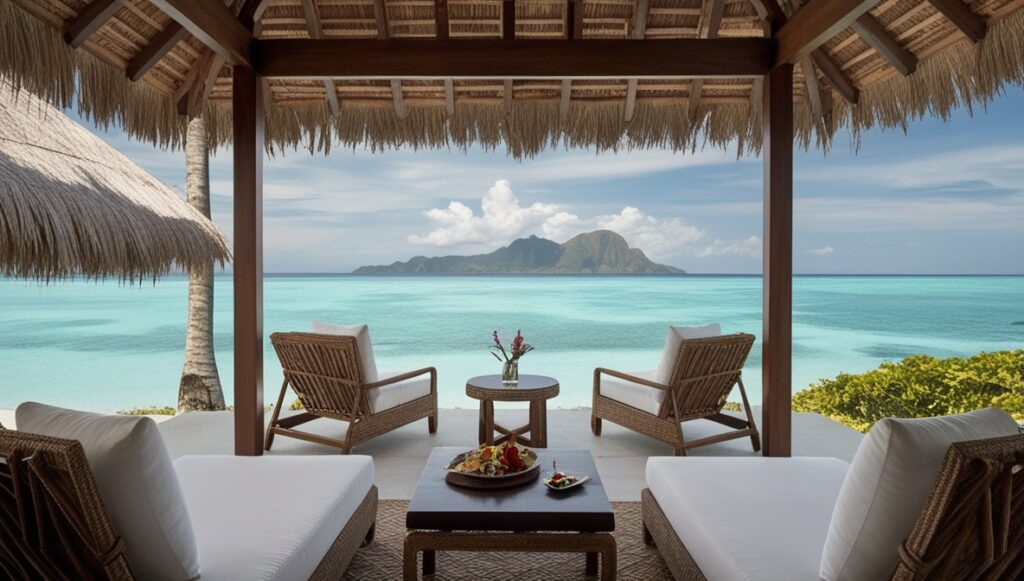
The northern end is calmer. It sits inside a natural nature reserve. There are fewer crowds, fewer motorbikes, fewer of the things that can make Boracay feel more like a theme park than an island. The resort occupies 12 hectares of hillside and beachfront within this zone, and its two private beaches — Punta Bunga and Banyugan — are accessible only to guests. No vendors. No strangers spreading towels next to yours. Just your own stretch of white sand and clear water.
The trade-off is distance. Getting to D’Mall, the central shopping and dining strip, requires a shuttle ride of about 20 minutes. The resort provides one, but it has limited evening hours. For guests who want to wander into town freely at midnight, this can feel restrictive. For guests who want to genuinely switch off and be somewhere peaceful, it’s exactly right.
The History Behind the Hotel
Shangri-La Boracay opened for business on March 2, 2009. It became the first and only five-star international resort on the island. It was also the fifth Shangri-La property in the Philippines.
Getting there wasn’t simple. Boracay’s northern end is an ecological reserve, and building inside it required demonstrating genuine environmental care. The resort’s approval came partly because of the sustainability commitments it made from the very beginning.
The broader Shangri-La Group began formalizing its sustainability strategy in 2007 — two years before this resort opened. The Boracay property was designed to fit into that framework from day one. Building materials were chosen carefully. Indigenous Filipino materials — abaca weave, capiz shells, local hardwoods — were woven into the interiors. The architect, a Hawaiian firm with global resort experience, was tasked with creating something that sat quietly inside the landscape rather than imposing on it.
When you walk through the resort today, you can feel that intent. The buildings don’t shout. They’re built into the hillside, separated by gardens, connected by shaded walkways. Monkeys have been spotted in the trees. Sea turtles have laid eggs on Banyugan Beach. Flying foxes roost in the forest canopy above the villas. This is not the kind of place that bulldozed its surroundings.
The Rooms, Suites, and Villas
There are 219 rooms and villas spread across the 12-hectare property. Even the most basic room — called a Deluxe Room — is not small. It comes with a private balcony with a daybed, marble bathroom, double vanity, separate rain shower and soaking tub, and views of the tropical gardens.
Step up to the Seaview Suite and you get a private outdoor hot tub on your balcony, butler service, and the kind of ocean view that makes it genuinely hard to leave your room.
But the villas are what people talk about.
There are 36 of them, in nine different configurations. Some are single-storey garden villas with private plunge pools. Some are two-level loft villas where the bedroom is on the upper floor with a wall of windows framing the jungle, and the living area opens onto a private pool below. The Treehouse Villas sit at the resort’s highest point, adults-only, with open-air jacuzzis and what several guests have described as the best jungle view on the property. The Presidential Suite clusters three villas together across 1,700 square metres, with a lap pool, outdoor gazebo, kitchen, and butler service around the clock.
Villa guests get a morning host and an evening host — not just a general concierge, but their own assigned staff member who knows their preferences and checks in personally. It’s the kind of service detail that sounds like marketing until you experience it and realize it genuinely changes the feel of a stay.
One small, unexpected joy: guests who stay in certain hillside villas have woken up to find wild monkeys sitting on their balcony railings, apparently very comfortable with the arrangement.
Dining: Four Very Different Restaurants
Food at Shangri-La Boracay is a bigger topic than most luxury resorts deserve, because each of the four restaurants feels genuinely distinct in atmosphere and purpose.
Vintana Asian Café runs all day. It’s the breakfast home — a sprawling international buffet that guests consistently praise for its variety and quality. Filipino rice dishes sit next to Japanese options, European pastries, and American eggs. It’s the kind of breakfast that turns into brunch without you noticing.
Cielo Poolside Restaurant & Bar sits next to the main pool, casual and breezy. Wood-fired pizzas, light dishes, cold drinks. Good for a lazy afternoon when you don’t want to leave the pool area but hunger has other ideas.
Sirena Seafood Restaurant & Clifftop Bar is the showstopper in terms of location. It perches above the water on a rocky cliff, with the sound of waves audible below. The menu focuses on seafood — though reactions from visitors have been mixed. Many guests rave about the cliffside atmosphere and the cocktails. Others have found the food inconsistent for its price point. The setting is undeniably spectacular regardless.
Rima Mediterranean Treetop Dining is the one guests tend to remember most fondly. It’s a small, intimate restaurant nestled among the treetops, open only for dinner, with limited seating that means reservations are genuinely necessary. The menu is Southern European — the kind of thoughtful, ingredient-focused cooking that doesn’t need a lot of drama to impress. Couples celebrating anniversaries or honeymoons tend to make a beeline for Rima, and it’s easy to understand why. Eating among the treetops while the sky turns gold over the ocean is the sort of thing that stays with people.
For villa guests, there’s a quieter option too: breakfast delivered to your villa, eaten on your private terrace with whatever view you happen to have that morning. Several regular guests have said this is how they spend most mornings, and it’s hard to fault the logic.
CHI, The Spa: A World of Its Own
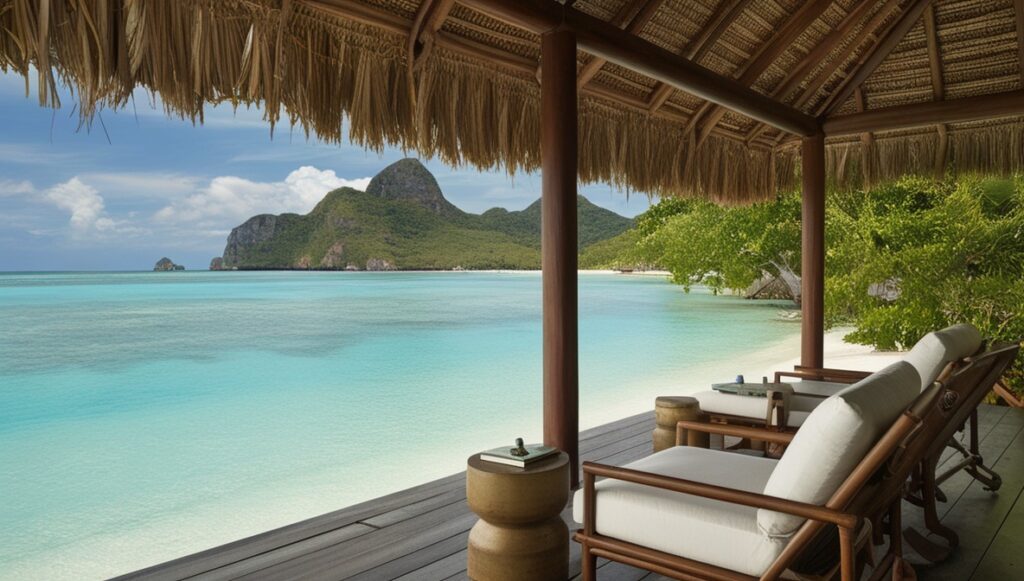
The spa at Shangri-La Boracay covers more than 5,000 square metres. That is not a treatment room attached to a hotel. It’s a village-within-a-resort, with its own reception building, dedicated treatment villas, a private spa pool, and a design atmosphere that pulls you into a different pace of time the moment you step through the doors.
The treatments draw from Filipino wellness traditions. The Hilot Massage is a traditional Philippine healing practice — a trained therapist uses warm coconut oil and banana leaves to read the body and identify tension and blockage, then works to release it. It’s deeply different from a Swedish massage, and guests who’ve never experienced it often describe leaving in a state of quiet surprise. The Kalinga Rice Scrub uses a mixture of local rice and coconut to polish and nourish the skin — using ingredients that have been part of Filipino daily life for generations.
There are also more conventional offerings: facials, body wraps, stone massages, hydrotherapy. The spa pool is reserved only for guests receiving treatments, which makes it unusually peaceful. One treatment gives you access for the full day, so people tend to linger.
The CHI Spa brand is part of the wider Shangri-La group and is consistently rated among the best hotel spas in Asia. At this property specifically, the combination of location — a coastal hillside, with sea breezes and the sounds of birds — adds something that can’t be replicated indoors.
The Environmental Story (and Why It’s More Than Marketing)
Shangri-La Boracay’s sustainability commitments were written into the property’s DNA before it opened. But the real test came in 2018, and the resort passed it in an interesting way.
In April of that year, President Rodrigo Duterte ordered Boracay’s complete closure to tourists. He called the island a “cesspool” — an uncomfortable word, but not an entirely inaccurate one. By 2017, two million tourists a year were visiting an island that had almost no adequate sewage treatment. Wastewater was flowing directly into the ocean. Illegal construction had swallowed the beachfront easement. About 400 businesses were found to be in violation of environmental laws. The government shut everything down for six months.
Shangri-La was among the first establishments given permission to reopen. Its track record of environmental management — plus the fact that it had never discharged wastewater improperly, had maintained its own ecological reserve, and had actively contributed to marine restoration — gave it standing that many other operators on the island did not have.
Since then, the resort has leaned harder into its environmental commitments. It built Boracay’s first on-site water bottling plant, using a purification system that produces both still and sparkling water in reusable glass bottles. The calculation is striking: this single initiative eliminates the need for at least 300,000 plastic bottles annually. In-room soap and shampoo dispensers replaced single-use plastic sachets. Key cards switched from PVC plastic to more sustainable alternatives.
The resort also brought bee colonies onto the property in 2022 as part of a wider effort to support island biodiversity. Guests can take a guided tour of the apiary, learn about the bees’ role in the local ecosystem, and taste honey that the bees produce on-site. Cocktails at the resort now sometimes feature that honey as an ingredient.
Then there is the fish house project. Guests can participate in making small handcrafted underwater structures that are placed in the waters around the resort’s beaches. These structures give fish and other marine animals shelter and encourage coral growth. It’s a simple activity, but it puts guests in a direct, hands-on relationship with the idea of looking after the ocean they’ve come to swim in.
The resort also keeps eight giant clams — locally called Taklobo — at Punta Bunga Beach. These animals, which are endangered, play a key role in filtering ocean water and supporting reef health. Sea turtles still nest on Banyugan beach. These aren’t publicity photos. They’re things that happen because the place has been managed with enough care to make them possible.
What the Criticisms Are, and Whether They’re Fair
Let’s be honest, because a complete picture helps more than one that glosses over the rough edges.
The most frequent complaint is price. Rates start around $326 a night for a base room, rise steeply with room category, and reach well into four figures for villas with private pools. Dining prices reflect this positioning — meals at Sirena or Rima are not budget options by any standard. Some guests feel the food quality doesn’t quite match what the prices imply, particularly at Sirena, where opinions on the food (versus the location and ambiance) have been divided.
The second common concern is remoteness. The resort is genuinely isolated from the lively part of Boracay. The shuttle runs on a schedule, stops around 10 PM for the return, and doesn’t give guests the freedom of simply wandering out on a whim. If your idea of the Boracay experience includes bar-hopping and spontaneous midnight adventures, you may find yourself frustrated.
A few reviewers have mentioned that the service, while generally warm, can occasionally feel scripted — the polished professionalism of a well-trained staff rather than the organic warmth of somewhere smaller and more personal.
None of these are dealbreakers for most guests. But they’re worth knowing before you arrive with specific expectations.
The Bigger Question: Is This Kind of Luxury Ethical?
This is the question that serious travelers are increasingly asking, and it deserves a direct answer rather than a corporate-sounding dodge.
Building and operating a large resort inside a protected eco-reserve is inherently in tension with the stated goal of preserving that eco-reserve. No amount of glass water bottles fully resolves that tension. The construction itself had an environmental footprint. The guests arriving by speedboat have flown long distances to get there.
At the same time, the alternative — leaving natural areas without any economic stake in their preservation — often leads to less controlled exploitation by smaller operators without the resources or incentives to manage environmental impact. Shangri-La Boracay’s presence has arguably created a model for what responsible operation inside a sensitive environment looks like.
The 2018 Boracay closure made this concrete. When the island was shut down for damaging the environment, hundreds of smaller operators — who had been dumping waste into the ocean, building illegally on the beachfront — were closed. Shangri-La reopened first, with its record intact. That’s not nothing.
The fairest conclusion is probably this: for a luxury resort inside a sensitive natural environment, this one appears to be trying harder and doing better than most. It’s not a perfect solution, because no resort in an eco-reserve can be. But the evidence suggests the commitment is genuine rather than decorative.
Final words
Real guests tend to agree on a handful of things.
The breakfast is memorable. Multiple reviewers, across years, have described it as one of the best hotel breakfasts they’ve ever eaten — not just for variety, but for quality. The international spread feels genuinely thought through rather than assembled by committee.
The villa hosts make an unusual difference. Having a dedicated person who knows your name, your preferences, and whether you like your morning coffee before or after swimming creates a warmth that a standard hotel concierge can’t replicate.
The sunsets. Every evening, guests tend to gather somewhere with a view westward. The sky above the Sulu Sea at sunset on Boracay does things to color that photographs can only partially capture. The resort’s position on the northwestern tip means it catches this light particularly well.
And then, the quiet. For guests who arrive from busy lives, the absence of noise — no traffic, no street vendors, no nightclub bass-thump from a nearby establishment — is itself described as a gift. One guest wrote that she couldn’t remember the last time she’d heard mostly just waves and birds. She stayed two nights longer than planned.
FAQs
1. How do I get to Shangri-La Boracay from Manila?
Fly from Manila (NAIA) to Godofredo P. Ramos Airport in Caticlan — the flight takes about 45 minutes. Resort staff meet you at the airport and guide you to a private lounge, then onto a speedboat that brings you directly to the resort in around 30 minutes.
2. Is the resort appropriate for families with children?
Yes. There’s a dedicated Adventure Zone indoor playground with slides and climbing structures. There are babysitting and nanny services (best arranged in advance). The breakfast buffet has kid-friendly options, and children under 6 eat free when accompanying a dining adult. That said, the Treehouse Villas are adults-only.
3. What are the two private beaches like?
Punta Bunga Beach and Banyugan Beach are both accessible only to resort guests. They’re calm, clean, and relatively small — ideal for swimming, snorkelling, and quiet mornings. Punta Bunga is the more popular of the two. Giant clams are kept in the waters here as part of a marine conservation project.
4. What’s the best room category to book for value?
The Deluxe Seaview Room is often recommended as the smartest entry point — you get ocean views, a generous balcony, and marble bathroom without the villa premium. If you want a private pool and butler service, the Loft Villa or Garden Villa are worth the step up.
5. Is there transport to the main part of Boracay (D’Mall, White Beach)?
Yes, the resort operates a free shuttle. The schedule is roughly every hour during the day, with the last return around 10 PM. For guests who want to explore the livelier parts of the island, this works well for daytime excursions. Late-night flexibility requires arranging a private tuk-tuk or taxi.
6. What activities are available within the resort itself?
Kayaking, parasailing, deep-sea diving, windsurfing, sunset sailing on a paraw (traditional Philippine outrigger), snorkelling, tennis, nature trail walks, the CHI Spa, the Adventure Zone, and the Eco Centre. There’s also a fitness centre with a jacuzzi and steam room.
7. How far in advance should I book a table at Rima?
Rima has limited seating and only opens for dinner. Book as soon as you confirm your resort stay — ideally a week ahead during peak season (December to May). Turning up without a reservation usually means disappointment.
8. What’s the CHI Spa like, and are treatments expensive?
The spa is a dedicated village complex with a private pool, separate treatment villas, and a range of therapies rooted in Filipino traditions alongside international treatments. It’s consistently rated among the best resort spas in Asia. Treatments are priced in line with a five-star international hotel — not cheap, but they’re thorough and genuinely exceptional according to most guests who experience them.
9. Did Shangri-La Boracay close during the 2018 Boracay rehabilitation?
Yes. All resorts on the island were closed from April to October 2018 when the Philippine government mandated the rehabilitation of the island’s damaged environment. Shangri-La was among the first properties granted permission to reopen, partly because of its track record in environmental compliance and management.
10. What sustainability initiatives does the resort actually run?
These include an on-site water bottling plant eliminating over 300,000 plastic bottles annually, in-room refillable soap and shampoo dispensers, biodegradable straws, eco-friendly key cards, an active bee apiary open to guests, a fish house-building program contributing to coral reef growth, and giant clam conservation at Punta Bunga Beach. The resort also participates in the wider Shangri-La Group’s “Rooted in Nature” culinary sustainability program.
11. Is it possible to visit as a day guest without staying overnight?
The resort historically offered a Day Pass for a fee that included use of facilities and lunch at Vintana. Availability and pricing can change, so it’s best to contact the resort directly to confirm the current arrangement before planning a day trip.
12. What’s the best time of year to visit?
November to May is generally the dry season, with calmer seas and more predictable sunshine. December and January are peak months — prices are highest, and the resort is busiest. March and April are popular with honeymooners. June to October is typhoon season; the seas can be rougher and some activities restricted, but rates are lower and the resort is quieter.
13. Is the food at Sirena worth the price?
Honest answer: the location and atmosphere are exceptional; the food is good but has received more mixed reviews than the other restaurants. The cliffside setting justifies at least one visit. Go for cocktails at sunset if you prefer not to commit to a full meal.
14. Do monkeys actually visit the villas?
Several guests in hillside villas have reported waking up to macaques sitting on their balcony railings or in the trees immediately outside. It’s not guaranteed, but it’s also not a rare occurrence. They’re wild and shouldn’t be fed.
15. How does Shangri-La Boracay compare to other luxury resorts on the island?
It remains the property most often cited as the island’s finest for seclusion, service, and natural setting. Newer properties like The Lind Boracay and Crimson Resort offer alternatives with different vibes. Shangri-La’s specific advantage is its location on a private northern bay, its villa options, and its track record — including its sustainability reputation, which has real substance behind it.
Read smarter, discover deeper with dailytheory.